AT & the coagulation cascade

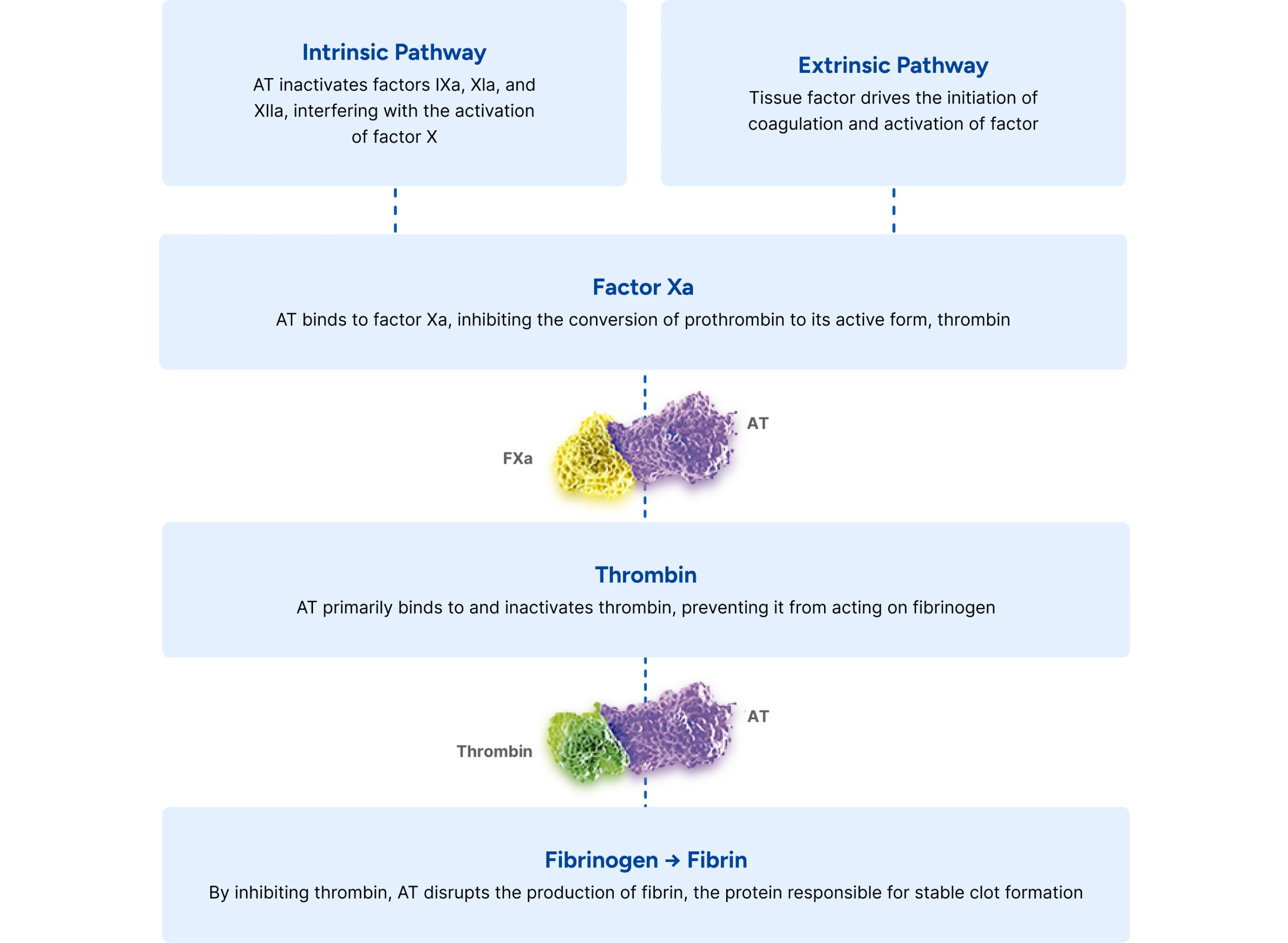
AT activity inhibits many clotting factors in the coagulation cascade in 3 key steps1-3

  1. Procoagulation factors bind to AT
  2. Once bound to AT, procoagulation factors are cleared
  3. The expansion of existing clots and formation of new clots are prevented
  • Antithrombin is a thromboprotective protein that inhibits the coagulation enzymes in a slow, progressive manner when heparin is absent. These enzymes include factor Xa and thrombin, and to a lesser extent, factors IXa, XIa, XIIa, and VIIa4
  • Antithrombin plays a key role in anticoagulation by preventing the activation of coagulation-promoting proteins except at the site of injury5
  • Antithrombin participates in a feedback loop in which blood can clot rapidly when needed but does not clot all of the time5
AT levels & Heparin

The role of antithrombin in thrombosis

  • 80% of the natural anticoagulant effect against thrombin is dependent on antithrombin6
  • AT activity inhibits many clotting factors in the coagulation cascade6

Cofactor Relationship Between Antithrombin and Heparin

  • Antithrombin inactivates multiple clotting factors in the coagulation cascade1,3
    • Binds irreversibly/inhibits prothrombotic actions of factor Xa and thrombin
  • The anticoagulant effects of heparin rely on its interaction with antithrombin
    • Heparin depends on antithrombin as a cofactor7
    • Heparin is ineffective in the absence or near absence of antithrombin3
    • The anticoagulant activity of antithrombin is accelerated >1000X when bound to administered heparin3
  • When antithrombin levels are deficient, activated procoagulant proteins circulate longer, increasing the risk of thrombosis8
  • Signs of heparin resistance could suggest an inherited clotting disorder, such as hereditary AT deficiency1,2,9-11

Impact of hereditary antithrombin deficiency on heparin action

  • Reduced concentrations of antithrombin as a cofactor for heparin action require increased doses of heparin9
    • Some patients may have resistance to treatment with heparin
    • Need for higher doses may provide diagnostic clue to hereditary antithrombin deficiency
  • Increasing heparin doses without considering the possibility of hereditary antithrombin deficiency can have deleterious effects11
    • Inadequate anticoagulation despite large intraoperative heparin doses
    • Excessive heparin dosing can lead to postoperative bleeding

The anticoagulant effect of heparin is enhanced by concurrent treatment with THROMBATE III in patients with hereditary AT deficiency. Thus, to avoid bleeding, the dosage of heparin (or low molecular weight heparin) may need to be reduced during treatment with THROMBATE III.

Heparin response issues

Antithrombin deficiency is the most common cause of low heparin response7,9

Dr. Stephen Bader discusses important considerations for before, during, and after surgery

Key Takeaways

  • Heparin response issues can occur in heparin-requiring surgeries, and administering additional heparin to overcome resistance could lead to bleeding at the end of the procedure
  • Low heparin response is commonly defined as needing a daily dose in excess of 35,000 units
  • Options to diagnose low heparin response in the operating room are limited, but interventions should be utilized to achieve the targeted ACT 
  • After the surgery, physicians may consider hematologic workup to make sure that a patient with low heparin response does not have hATd
  • Patients with hATd need to be identified for appropriate management postoperatively and during future surgeries and life events, such as childbirth, which further increase the risk of thrombosis

Learn more about THROMBATE III

Resources

Find resources for THROMBATE III

Learn More

AT III Deficiency

Learn more about hATd

Learn More

VTE Risk

Explore how AT impacts VTE risk

Learn More

THROMBATE III vs FFP

Discover the difference between THROMBATE III and FFP

Learn More

Have a question about THROMBATE III?

Get in touch with a representative today

Important Safety Information

THROMBATE III (antithrombin III [human]) is indicated in adult and pediatric patients with hereditary antithrombin deficiency for treatment and prevention of thromboembolism and for prevention of perioperative and peripartum thromboembolism.

Hypersensitivity reactions may occur. Should evidence of an acute hypersensitivity reaction be observed, promptly interrupt the infusion and begin appropriate treatment.

Because THROMBATE III is made from human blood, it may carry a risk of transmitting infectious agents, eg, viruses, the variant Creutzfeldt-Jakob disease (vCJD) agent, and, theoretically, the Creutzfeldt-Jakob disease (CJD) agent. There is also the possibility that unknown infectious agents may be present in the product.

Perform coagulation tests to avoid excessive or insufficient anticoagulation and monitor for bleeding or thrombosis. Measure functional plasma AT levels with amidolytic or clotting assays; do not use immunoassays.

In clinical studies, the most common adverse reactions (≥ 5% of patients) were dizziness, chest discomfort, nausea, dysgeusia, and pain (cramps).

The anticoagulant effect of heparin is enhanced by concurrent treatment with THROMBATE III in patients with hereditary AT deficiency. Thus, in order to avoid bleeding, the dosage of heparin (or low molecular weight heparin) may need to be reduced during treatment with THROMBATE III.

Please see full Prescribing Information for THROMBATE III..
References

  1. Maclean PS, Tait RC. Hereditary and acquired antithrombin deficiency: epidemiology, pathogenesis, and treatment options. Drugs. 2007;67(10):1429-1440.
  2. Li W, Johnson DJD, Esmon CT, Huntington JA. Structure of the antithrombin–thrombin–heparin ternary complex reveals the antithrombotic mechanism of heparin. Nat Struct Mol Biol. 2004;11(9):857-862.
  3. James AH, Konkle BA, Bauer KA. Prevention and treatment of venous thromboembolism in pregnancy and patients with hereditary antithrombin deficiency. Int J Womens Health. 2013;5:233-241.
  4. Finley A, Greenberg C. Review article: heparin sensitivity and resistance: management during cardiopulmonary bypass. Anesth Analg. 2013;116(6):1210-1222.
  5. Kovács B, Bereczky Z, Oláh Z, et al. The superiority of anti-FXa assay over anti-FIIa assay in detecting heparin-binding site antithrombin deficiency. Am J Clin Pathol. 2013;140(5):675-679.
  6. Hsu E, Moosavi L. Biochemistry, Antithrombin III. In: StatPearls. Updated September 4, 2023. Accessed September 3, 2025. https://www.ncbi.nlm.nih.gov/books/NBK545295/.
  7. Kottke-Marchant K, Duncan A. Antithrombin deficiency: issues in laboratory diagnosis. Arch Pathol Lab Med. 2002;126(11):1326-1336.
  8. Mitton BA, Steineck A. Antithrombin deficiency. eMedicine from WebMD. Updated July 29, 2022. Accessed September 3, 2025. http://emedicine.medscape.com/article/198573-overview.
  9. Patnaik MM, Moll S. Inherited antithrombin deficiency: a review. Haemophilia. 2008;14(6):1229-1239.
  10. Pabinger I, Schneider B. Thrombotic risk in hereditary antithrombin III protein C, or protein S deficiency. Arteroscler Thromb Vasc Biol. 1996;16(6):742-748.
  11. Ranucci M. Antithrombin III: key factor in extracorporeal circulation. Minerva Anestesiol. 2002;68(5):454-457.